Aspsås Prison Block B Workshop
Three SecondsAspsås Prison Block B Workshop is the central physical setting of the prison crisis’s final confrontation: a yard-facing space where Piet Hoffmann’s exposed position is watched through the prison’s security system, and where the aftermath of a shot and explosion becomes the subject of forensic reconstruction. Its significance lies in the convergence of the prison’s controlled architecture, the crisis unfolding inside it, and the evidence left behind in the damaged building.
Setting and the Prison’s Controlled Space
The workshop belongs to a larger institution in which movement between buildings and units is managed closely. Before his first entry into Aspsås Prison, Hoffmann had already mapped its buildings from the church tower and studied the bars on its windows. He had also learned, with Erik Wilson’s help, about the prisoners and staff in Block G. That prior knowledge did not substitute for entering the prison: arrival brought guards, registration, and a succession of controlled thresholds. The distinction between a prison observed from outside and one physically entered establishes the setting’s tightly regulated character.
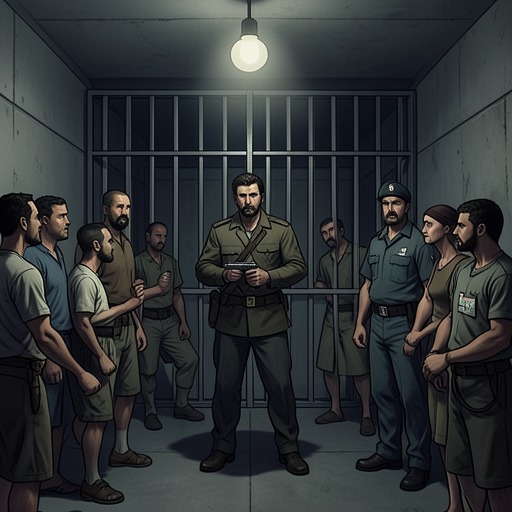
Inside, formal routines and informal inmate expectations shape how people occupy space. After Hoffmann is shown his unit and its rules, he takes a conspicuous place in the TV corner before the other prisoners return, making sure that his arrival is noticed. At supper, two older inmates challenge him to produce his papers; Stefan Lygas and Karol Tomasz Penderecki, who have prepared other prisoners for his arrival and assembled records about him, initially move to intervene. Hoffmann lets the questioning proceed. These episodes do not take place in the workshop, but they establish the prison’s layered order: official procedures govern movement, while reputation and peer recognition determine how a newcomer is received.
The prison’s divisions also matter as the crisis develops. When Hoffmann is moved from Block G to voluntary isolation in Block C, a riot squad escorts him across the yard and through the prison. Later, Mariana Hermansson discovers that the explanation given for his supposed isolation in the hospital unit was false: the doctor says Hoffmann had not been there and no epidemic had been identified. The workshop’s place in this multi-block setting makes the crisis part of a wider system of access, concealment, and movement rather than an isolated disturbance.
Surveillance and the Hostage Confrontation
The workshop’s yard-facing window gives the crisis a visible focal point. From the central security room, Bergh watches a monitor connected to a camera that has been turned away from a concrete wall. He makes room at the desk and links up to transmit the picture across all sixteen screens. The feed shows Martin Jacobson naked and bound, with Hoffmann holding him and a miniature revolver to his head. Hoffmann steps back so that the weapon can be seen. Surveillance here does not prevent the threat; it carries its image through the prison and makes the hostage situation legible to those watching elsewhere.
The workshop window also places Hoffmann in a position that can be observed from outside the building. Forensic investigator Nils Krantz later identifies it as the window visible from the church tower, where Hoffmann stood fully exposed during the drama. That relationship between tower, window, and workshop gives the confrontation a precise spatial axis: a distant vantage point can see the building, while the damaged window and the evidence inside it allow investigators to reconstruct what happened.
Fire, Damage, and Forensic Reconstruction
After the confrontation, Mariana turns back toward the prison and sees thick black smoke forcing its way through a large opening where a window had been in the front of the workshop building. The fire marks an abrupt change in the site’s status. A prison workplace has become the conspicuous scene of a crisis, then a damaged structure whose altered surfaces preserve evidence.
The following morning, prisoners have been evacuated from Block B to Block K. The building remains cordoned off, still echoing from the explosion and formally treated as both a crime scene and part of an investigation. Four forensic technicians work among the charred workshop and soot-marked walls. The smell of diesel oil remains throughout the area, a trace of the conditions described as poisonous the previous day. The evacuation clears the block for examination, while the cordon turns an ordinary prison space into an evidentiary one.
Krantz leads Ewert Grens and Sven Sundkvist to a hole in the workshop wall, roughly the size of a grapefruit, and indicates the line across the room from the window. His reconstruction identifies fire and explosive ammunition, an initial velocity of 830 metres per second, and a three-second interval between the shot and its target. The workshop’s damage therefore records more than the fact of an explosion: the window, wall opening, and line of fire let investigators map the shot against Hoffmann’s visible position. Krantz’s account also gives the building a second role in the investigation, as a fixed point from which a criminal event can be reconstructed after it has happened.
Narrative Significance
The workshop concentrates several features of Aspsås Prison into one location. It is part of an institution divided into controlled blocks, yet its window opens the crisis to surveillance and a view from the church tower. The central security room can distribute an image across sixteen screens, but the monitoring does not resolve what those screens reveal. Afterward, the same building is read through its damage: smoke identifies the immediate rupture, and forensic measurements establish the trajectory and timing of the shot.
This shift from watched space to crime scene gives the workshop its particular narrative force. During the crisis it is a place where a hostage and captor are visible but not thereby safe; afterward it is a structure whose physical marks support an account of events. Its window connects exposure to observation, while the hole in the wall converts that exposure into evidence. The workshop thus anchors both the unfolding emergency and the later effort to understand it.